
Whoops and indoor
Ducted props, a plastic canopy, and a crash you can usually walk away from. This is the Tiger Moth: slow, cheap, and the right place to learn orientation.
Home / Types
Dossier 03 / Multirotor
Four rotors, two pairs of opposite spin, one stiff cross. The quad is the Hurricane of the drone world: not the only type, but the one most students will meet first.
A single rotor needs a tail rotor or a coaxial pair to kill torque. A quad kills torque by geometry: two motors turn clockwise, two counterclockwise. Yaw is just an imbalance between those pairs. There is no swashplate and no tail boom. The cost is efficiency. Four small discs move air less kindly than one large rotor or a proper wing.
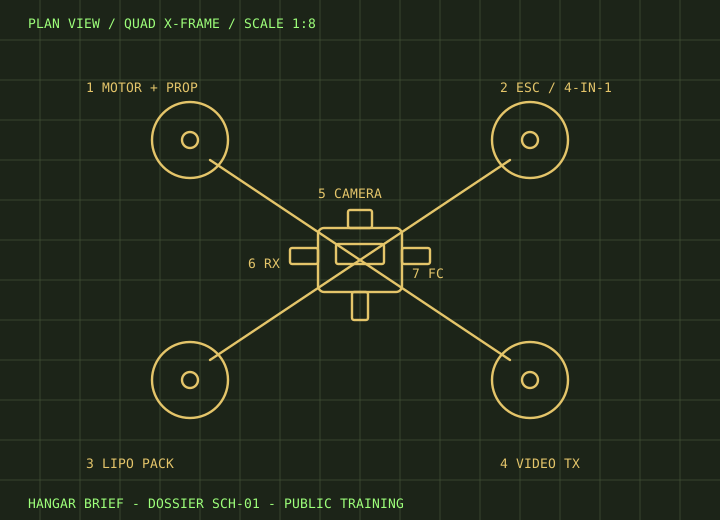
The X layout puts a motor at each corner and the camera in the gap. An H layout leaves a clearer camera lane. Deadcat and stretched-X frames kick the front motors out of the lens. Those are the planform choices, as real as choosing a straight wing or a clipped one.
On a modern 5-inch racer the brain sits in a sandwich: flight controller on top, 4-in-1 ESC below, packed between the carbon plates. Receivers, GPS, and the video transmitter hang on the ends of short leads. The stack is the cockpit. If it is dry, isolated from motor noise, and firmly mounted, the rest of the airframe can be light.
Size classes
Ducted props, a plastic canopy, and a crash you can usually walk away from. This is the Tiger Moth: slow, cheap, and the right place to learn orientation.
Ducts for flying near people and trees. Heavy for their size because they carry a recording camera. Think army co-operation: close, careful, useful pictures.
The common FPV racer and freestyle machine. Enough thrust to hover at a third throttle, enough speed to make a mistake expensive. Most desktop simulators are tuned to this class.
Longer arms, bigger props, cameras or radios that need time on station. Closer to a light bomber than a racer: you fly energy and wind, not just gates.
A quad can take off from a table, stop in a doorway, and look at a roof tile. That is the gift of thrust-to-weight and no stall speed. It is also why film crews, inspectors, and first-person racers all ended up on four motors. The same geometry that makes a hover easy makes a long cruise wasteful. If the job is a 40 km survey line, you want a wing.
Builders still argue about motor kv, tune, and rates the way engine fitters argued about boost. The useful fact for a student: more thrust than weight makes the machine forgiving. A thrust-to-weight near 2:1 is a trainer. Near 8:1 is a fighter. Our browser hop sits in the trainer band on purpose.